I could have released Novel the Board Game in 2024.
It seemed like such a gift. Just as my board game design was coming together and I was trying to decide what to do, I tried it. It was so fast. The results were consistent and polished. All I had to do was type words. I’m good with words. And it was fun. Add a phrase here, edit a word there, and boom! A brand-new result in just seconds. More professional than something I could put together no matter how many hours and hours of work I might put in. Machines are faster than humans.
But the dream was a faulty one.
I’m talking about generative AI used to create “art.” I’m putting the word “art” in quotes for good reason. As a writer, artist, and entertainer for many years, I’ve always felt that art comes from the artist’s heart, mind, and soul. It’s an expression of a person’s understanding about the world. Their thoughts and feelings.
Machines have none of those things. No heart. No mind. No soul. No understanding. No thoughts. No feelings.
The only thing generative AI can do, when it comes to art, is make a shadow of human expression. A simulacrum, a copy, a reconfiguration.
A fake.
Art needs an artist. So, I sighed inwardly, took what I had learned about the idea, understood it for what it was, and got back to work.
Where It Starts
I’ve been drawing since I could hold a crayon, but I never took art classes in school until college. There were art classes in high school, taught by a married couple who (I’m sure they had good intentions) failed students who weren’t able to draw and paint the same way that they would draw and paint. Come to think of it, they were a primordial version of an AI model because they were more interested in teaching students how to copy what they did than encouraging the skills needed for students to express themselves.
Then, in college, I took an art class. Our first textbook was Drawing on the Right Side of the Brain by Betty Edwards. The idea I remember best is that you can only draw what you can accurately see. Many of the exercises we tried helped us to transition from what we think we see to what we actually see in reality. This is why artists paint from references, live or photographic, to get verisimilitude.
For me, drawing and illustration is often done best when it’s done as a human reflection of reality.
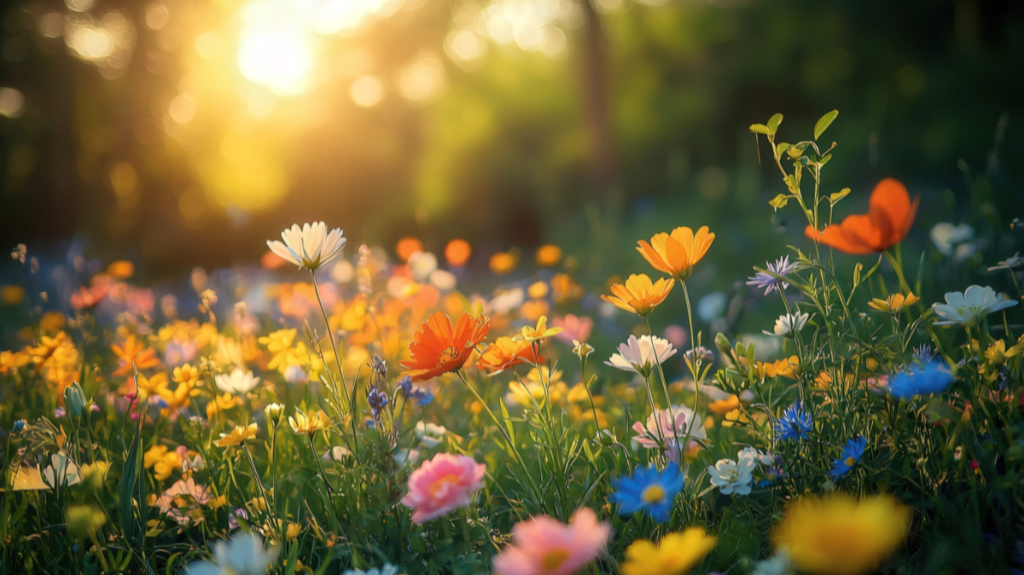
The photograph above is one I licensed from 123RF.com. I have a subscription for commercial use, which lets me download anything that I might want for reference in my art for the game. You can find the same photo, if you want, by searching for image number 253456950.
I use photos for several reasons. First, the photographers are getting paid. Second, the image delivers realism and natural composition even when I modify it.
Using 123RF for sourcing also has benefits because they label any art created by generative AI. It’s simple to avoid images I don’t want by checking the tags, and I know that when I select an image I’m getting an asset that was made by a person, an artist, who has been granted credit and a fee.
Adding Filters
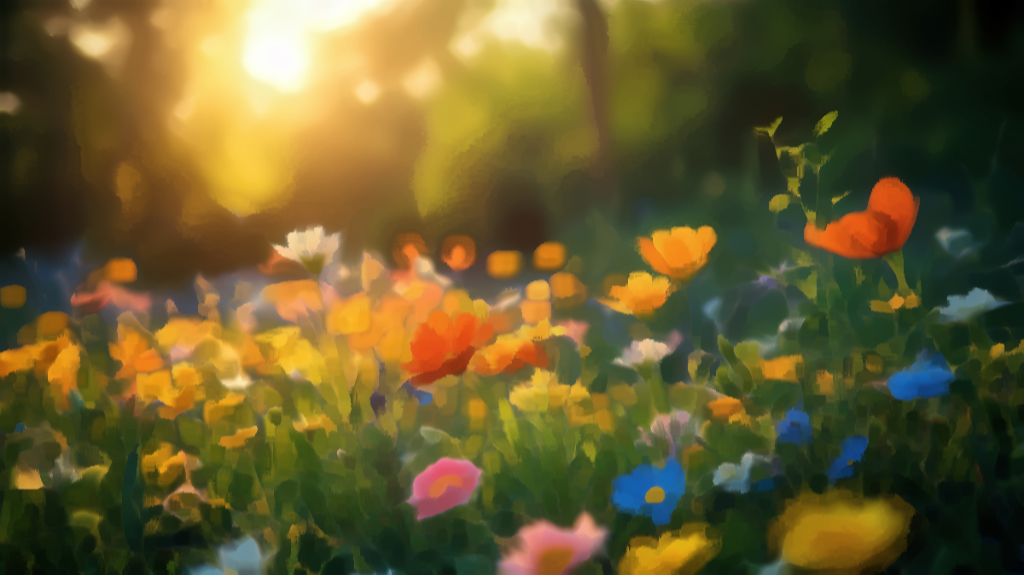
This is the same photo after processing it through one or more of the artistic options in the Affinity Photo filters in the G’MIC-Qt plugin. I use these filters to make the image more “painterly” because it’s the closest thing to my art style.
Once the image is updated, it can be used as placeholder art for prototyping and playtesting. None of this art will end up being used in the final version of the game. It’s a quick way to compile temporary assets to make sure the game is designed well, but it is not a permanent solution.
Hand painting
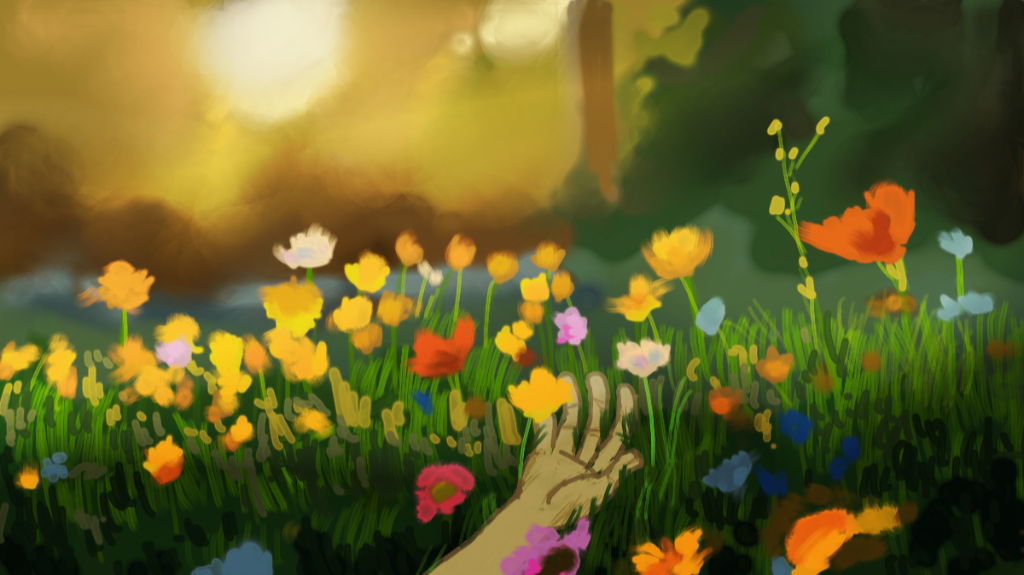
Here’s the image after I’ve painted it by hand. Every single pixel was done by me on my iPad; nothing remains of the original. This background will become a Setting Tile in the Mystery genre, which explains the extra bit of work that wasn’t in the photograph. (NOT based on reality. Don’t call the police.)
This is only one of the strategies implemented for creating the game’s art. Some of the art has been created from scratch because I do like what comes from my own inner reality when I can see it. Some has been a composite of two or more pieces; and some has been painted and guided by referenced sources. or a combination of all the above.
Formatting for Gameplay
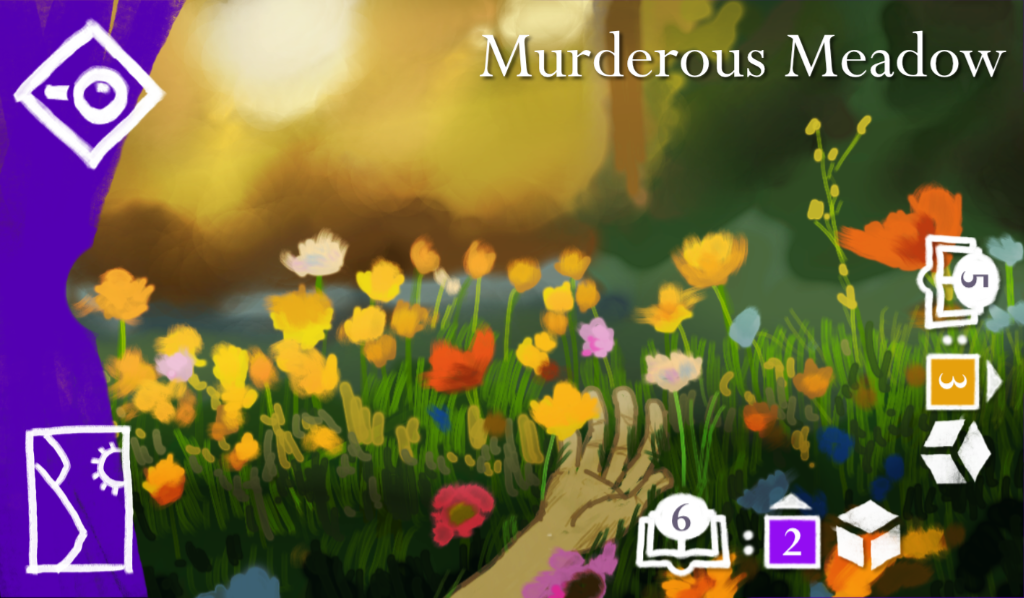
Once a piece of art is “finished,” (for the time being) it is placed in a template that makes it a card or a tile for play. Cards and tiles are produced in different sizes for different purposes and gameplay overlays get them into their genre or type ready for testing.
Placeholder art will eventually be replaced with hand-painted art. The hand-painted art will also be revised and updated before everything is truly finalized.
Nothing Artificial
Initially, briefly, it was difficult to choose to create art by hand instead of taking the quick-and-easy road and using AI “art.” There are also many extraordinary artists out there creating incredibly beautiful art for board games. I admire them, learn from them, and hope to become more like them. Yet there is another principle at play that is even more important than making my game beautiful. That principle is knowing that the game is all mine.
My heart. My mind. My soul. My understanding. My thoughts. My feelings.
When Novel the Board Game finally hits the shelves, it won’t have perfect art; however, it will have my art, nothing artificial.
That’s the best art it could possibly have.